Cupcake by Rachel Cohn is the third book following the misbehaviors and adventures of Cyd Cherisse, which begin in Gingerbread and continue in Shrimp.
C.C. aggravates the hell out of me a lot of the time, being all rich-girl angsty and so on, but she ends up scootching toward “responsible” with each book without turning all goody two shoes. Plus, who wouldn’t eventually love an avowed bad girl in miniskirts and combat boots who also carries a rag doll (Gingerbread) around in a metal lunchbox and makes friends with old people with names like Sugar Pie?
If you enjoy snarky humor or are looking for books that unpack the real challenges of coming from a wealthy family and yet wanting to chart a unique course, check out this trio of novels.
Bonus: the narrator for the audio version of all three books is just great. Her voice is a cross between the Nanny (Fran something or other—you folks who grew up in the nineties know who I mean) and a sexy French teacher. So much better than my description would seem to suggest.
One of the things I love about reading YA is discovering new company for books I love–especially imagining how I’d group them and what recommendations I’d offer to folks who’ve loved a book.
Here’s the Library of Congress book summary:
In the three years since her father caught her in the back seat of a car with an older boy, sixteen-year-old Deanna’s life at home and school has been a nightmare, but while dreaming of escaping with her brother and his family, she discovers the power of forgiveness.
A while back I blogged about connections between Blythe Woolston’s The Freak Observer and my first novel, What Can’t Wait. For readers who liked either or both, my next recommendation would be Story of a Girl. Some common denominators: family tensions, financial stress, a sibling/niece who is a source of concern and love, identity quests, and less-than-healthy encounters with the opposite sex.
In Story of a Girl, Zarr cracks open and humanizes a character whose self-esteem has taken a hit because of bad choices and the bad luck of living in a small town where fresh starts are hard to come by. And everything about Deanna’s thought process (as a very young teen drawn to the attention of an older guy) rings true–to be desired (and noticed) at that age is just intoxicating–and dangerous for sense of self. I had similar thoughts and responses when I got a little of the wrong kind of attention from my older brother’s friend when I was twelve.
Another something amazing: Zarr shows how friendship can reshape our lives–and our ways of responding to hurt. When Deanna betrays a friend and receives forgiveness for it, that starts to change how she relates to other people in her life, including her dad and the boy who took advantage of her when she was just a girl.
Read more about my thoughts on teens and sex here. Because teens do have bodies that matter, and sex is part of what we all think and live.
PS I give Deanne permission to like her English teacher and keep a writer’s notebook because she isn’t all dorky and pretentious about it (as I probably was back when I was in high school). Consider her untouched by the gripes in this earlier rant.
Love this artist’s stuff on flickr. Here, turning spam messages into art.
One of my favorite things about being a bookish person is crossing paths with other bookish people. And what I like best about those experiences is when I meet someone who reads like I do, which means we share both a number of past experiences with books as well as the potential for a reading future together. Such a person’s book recommendations are worth their weight in gold. So are the potential conversations we might have.
The first time this happened to me was with a professor/mentor type at UT Austin when I was an undergrad. I never had a class with Brian Doherty–my loss–but he always ran the UT writing contests, and so I got to know him through that. (Any time my writing had the potential to earn me cash, you better believe I was in!) We loved a lot of the same books, and so when he recommended Junot Díaz’s collection of stories, Drown, I was in 100%. Same with Mistry Rohinton’s A Fine Balance and a ton of other delicious reads. But what I liked best was the surprise and delight of the books we both had under our belt.
Of course, book serendipity shows up in all kinds of other ways, too. Like last week I discovered that my editor, Andrew Karre, was behind one of the first YA novels that got me interested in writing YA myself, How It’s Done, by Christine Kole MacLean. This entry from his blog exposed the connection. Here’s the relevant bit:
The very first YA novel I acquired, edited, and published entirely was a realistic YA (How It’s Done by Christine Kole MacLean). Novels like Christine’s were a prime entry point for me–they’re the Neapolitan of my YA reading life–but I pretty quickly branched out, and now I value all of the ways the various YA sub genres riff on the basic YA ingredients and techniques: teenage experience and character-driven storytelling.
The funny thing is, the part about How It’s Done is just a small example in the post, which is really about genres and sub-genres in YA, but it was the point of spark and excitement for me in reading it. In my head, Andrew’s post is filled under “Holy cow, Andrew and I have another book in common” and “How cool is it that Andrew edited this book?!”
By the way, even though How It’s Done isn’t my favorite book of all time, what caught my attention was how it was built in part out of a world I recognized (the evangelical community). Somehow that recognizable aspect made the idea of writing a N.O.V.E.L. seem less daunting. Like maybe it could be thought in lowercase letters.
So every once and a while my writing group will do a writing exercise together. I think these are great because they produce surprises. Lots of times lazy me writes things that I can use in my current book project (why waste effort? why not be surprised with usable material?), but occasionally I just have fun. These entries were from a prompt on getting rich quick. When my group member read the prompt, she said, “Number 168, get rich quick.” I heard the “Number 168” as part of the prompt, which is why I ended up writing fake, numbered, get-rich-quick tips. Apparently, though, 168 was just the number of the prompt.
Hey, who cares as long as some play or writing comes out of the exercise?
Get Rich Quick #168. Wealth is a habit of mind—collect bottle caps, cover them with a handkerchief, and will them to be gold pieces.
Get Rich Quick #418. Have piles of phone books? Think of all those yellow pages as free toilet paper. Money you don’t send is money in the bank. Quick is relative.
Get Rich Quick #1328. Get a job as a bellhop so you can spend your days opening doors for strangers. Karma will be on your side.
Get Rich Quick #46. Join a pyramid scheme, being sure to join it at the top.
Get Rich Quick #232. Discover gold, oil, or the lost pet of a tycoon.
Get Rich Quick #111. Volunteer to take the collection at your church, and then do so.
Here’s what happens if you’re me and you wish you could digitize the essentials of your personal library and take it with you for your year in Paris: you mope around saying things like, “Man, wish I could digitize my library and take it with me. Oh well.”
Here’s what happens if you’re an engineer and you think something similar: you build a super-fast, easy-to-use, do-it-yourself book scanner.
Check out what my web designer Justin Ray worked up here. And if you’re a little more motivated than I am, you’ll channel your inner engineer and have a rocking tool to digitize your library. Justin’s post has more details, but here are his Youtube video demos to tantalize you:
{youtube}Z-wJs3Xg4Y4{/youtube}
{youtube}6C_yJ7eMs24{/youtube}
P.S. Justin also does the web design for my site and designed a super-cool (and free) Joomla plugin that you can use to integrate Goodreads reviews directly (and automatically) into your own site. Read more at www.314pies.com.
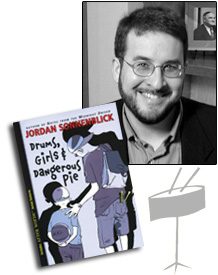
I admired Jordan Sonnenblick before I even knew his books. Like me, he put in a number of years teaching in the public schools of Houston through Teach For America. Plus he’s a funny, unassuming guy who is unstinting when it comes to sharing his experiences. Among other things, he gave me heaps of advice about managing publicity and pulling off high-quality author visits.
Maybe all this awesomeness contributed to the moment of fear that struck my first-time-author heart: what if I don’t like the work as much as I like the person?
Not to fear, though: Drums, Girls, and Dangerous Pie and the companion novel After Ever After hit all the right notes. These are middle-grade fiction at its best. Put it out there for guys or girls. Serve it up in class or outside. These books are real without crossing any of those tricky boundaries that are so worrisome for librarians and teachers of the younger crowd.
Here’s a quick summary of the two books (excerpted from the positive Kirkus reviews of the books) before I touch on some of the things that I liked best:
Drums, Girls, and Dangerous Pie (2005): Steven Alper, who is untalented in sports but terrific on the drums, is giving his pesky five-year-old brother Jeffrey oatmeal when Jeffrey, who has been complaining recently that his “parts hurt,” falls off a stool and gets a nosebleed that just won’t quit. That night Steven finds out that Jeffrey has leukemia.
After Ever After (2010): In this companion novel to Drums, Girls & Dangerous Pie (2005), Steven’s little brother Jeffrey, now in eighth grade and in full remission from leukemia, discovers that happily ever after isn’t quite what he expected.
I accidentally listened to these books out of order, hearing Jeffrey’s story in After Ever After before Steven’s. It didn’t really matter, though, because After Ever After really is a companion book, not a sequel, and nothing is lost for readers who haven’t read D,G, and DP. The self-deprecating humor and general wholesomeness of the guys is a common thread, but Steven and Jeffrey’s challenges, strengths, and outlooks are appropriately distinguished. Together, the two novels offer a view of how childhood cancer affects–and continues to affect–families.
After Ever After in particular helps readers think about something that they might not consider: the many costs and complications of life for a childhood cancer survivor. Jeffrey and his friend Tad (also a cancer survivor) have to live with side effects from treatment that touch everything from their fine motor control to their walking ability, their memory to their problem-solving skills. (FYI I was intrigued to hear mention of Gleevec as a treatment for one of the boys as this is the medication my Dad has been on as a treatment for gastrointestinal cancer.)
For all their differences, both Steven and Jeffrey are the kind of sweet but not too sweet boys I hope that Liam will grow into. The books are clean but not squeaky; Sonnenblick’s pitch-perfect voice keeps the reader from ever thinking for a second that the writer is writing at a younger audience. This is writing for middle-grade readers at its best.
I know I mentioned the humor already, but really. Really. So funny. Like Tad in After Ever After calling his little sister the “emergency replacement child” that his parents cooked up just in case he croaked. In light of my colossal inability to generate humor, this kind of funny floors me.
Liam, will you please read these books with me when you are approaching your middle-school man-child years?
“I found America the friendliest, most forgiving, and most generous nation I had ever visited. We South Americans tend to think of things in terms of convenience, whereas people in the United States approach things ethically.This–amateur Protestant that I am–I admired above all. It even helped me overlook skyscrapers, paper bags, television, plastics, and the unholy jungle of gadgets.”
Borges wrote this in 1970. I wonder what he’d think of today’s jungle of gadgets?
Borges traveled on the lecture circuit in the U.S., but he also spent a good while as a visiting professor at my alma mater, The University of Texas at Austin. I imagined him moving slowly (he was blind at the time, after all) through Parlin Hall, the English building where I had most of my classes.
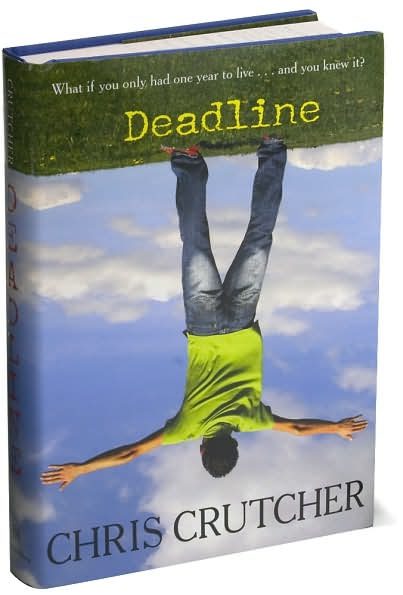
I just finished listening to Chris Crutcher’s Deadline, and doing so was both a pleasure (I’ve loved Chris Crutcher since listening to his fabulous Whale Talk) and a chance to think about the relationship between realism and diversity in YA.
But first, here’s the skinny on Deadline, courtesy of the Library of Congress (where I go for the best book summaries):
Ben Wolf has big things planned for his senior year. Had big things planned. Now what he has is some very bad news and only one year left to make his mark on the world.
How can a pint-sized, smart-ass seventeen-year-old do anything significant in the nowheresville of Trout, Idaho?
First, Ben makes sure that no one else knows what is going on—not his superstar quarterback brother, Cody, not his parents, not his coach, no one. Next, he decides to become the best 127-pound football player Trout High has ever seen; to give his close-minded civics teacher a daily migraine; and to help the local drunk clean up his act.
And then there’s Dallas Suzuki. Amazingly perfect, fascinating Dallas Suzuki, who may or may not give Ben the time of day. Really, she’s first on the list.
Living with a secret isn’t easy, though, and Ben’s resolve begins to crumble . . . especially when he realizes that he isn’t the only person in Trout with secrets.
Discounting the mention of Dallas Suzuki, you might be wondering where diversity would come into play in the white, white world of Trout, Idaho. And that’s what I love about this book: it’s true to its rural setting without giving up on the idea that diversity matters. Ben is white, as are almost all of the kids at his school and in his town. But—like my younger self growing up in rural East Texas—he cares about what’s happening in the rest of the world.
He’s fascinated by The Autobiography of Malcom X as well as Lies My Teacher Told Me, both of which influence him to discover the subtext of discrimination and prejudice in his hometown. (Without, by the way, ceasing to care deeply about the town and his neighbors.) BTW, I’m guessing that the cranky Kirkus reviewer who criticized “Crutcher’s heavy-handed lessons on the ills of racial prejudice and the need for gun control” read the good ole boy attitude of some of Trout’s citizens as exaggerated. I don’t think it was. And for the record, I’m from Kilgore, Texas, a town where the concentration of Republicans and guns is just about as heavy as it gets. (I still love you, East Texas.)
Now, there are many other things I enjoyed about Deadline, including Ben’s self-deprecating sense of humor and his dream conversations with a wise man who goes by Hey-Soos. (Yes, Ben’s therapist helpfully points out that Hey-Soos is phonetically identical to the Spanish pronunciation of Jesus.) They talk about free will, moral relativism, relationships, and how premarital sex can be healing for Dallas, who turns out to have survived sexual abuse. Fascinating stuff that leaves readers thinking.
So: the challenge of embracing a diverse world from a not-so-diverse corner of that world isn’t the focus of Deadline, but it is there. And it’s there in such a way that it never subverts the realism of Crutcher’s world.
I do notebooks full of prewriting (zero-drafting in my world) before officially “starting” a novel, but I don’t outline before writing. It just doesn’t work for me.
Outlining does work for me, though, in the middle of a project and in the revision stages. At this point, an outline is more about understanding the shape of what I’ve written than using a list to decide what to write next. I outline in a number of different ways, but one of my favorites is to make thumbnail sketches of each chapter that consist of the first and last event as well as any key plot point in that chapter.
The first/last thing is a great way to “out” any chapter that’s not pulling its weight because it helps me to see how a chapter moves the story forward. When I’m finished, I have the movement of the whole book contained in a few pages of my writer’s notebook, and I don’t get lost in the details. Often this exercise helps me uncover structural imbalances and inspires me to think about how I can build up portions of the book that seem flimsy in comparison to other sections–or trim down flabby bits.
Here’s what it looks like in my writer’s notebook when I do this exercise (this is on an early draft of What Can’t Wait):
I try to think about how a chapter contributes to the forward movement of the book as well. Does it make the reader anticipate what’s next, or am I just coasting? Coasting chapters call for rethinking, at least some of the time. Even when you want to balance a lot of action with a mellower chapter or two, it’s important that what feels to the reader like a decrease in action is nevertheless full of strategically placed pieces that can become (retrospectively) important.
Oh, and I don’t just do this outlining for my work, either. If I think a book is amazing and am trying to learn from its structure, I’ll do the exercise with it. I did this with Jenny Downham’s lovely Before I Die and Markus Zusak’s The Book Thief.
A question for the universe: does social media make being a teen easier or harder?
I’m guessing this is one of those questions that tends to have “yes and no” as its most honest answer.
Here’s how I figure it.
The good thing about social media is that, for teens like me who grew up in rural areas, there’s the possibility of accessing a broader world and encountering folks with broader worldviews a little bit sooner. (Hey, maybe fewer teens will have to drop out of high school like I did just to get away…) Not just rural teens, but for anyone feeling marooned socially. From this point of view, the Internet offers access to a lot of connections that can affirm the basic “It Gets Better,” high-school-isn’t-everything message (especially important for LGBT teens).
But I wonder if social media doesn’t make all the drama of high school that much more inescapable? Does it open up new avenues for persecution and damage? This is the part I really don’t know about first hand since I did not come of age under the rule of Myspace, Facebook, and company.
So, universe, what do you say? If we toss the pros and cons on the scale, how do today’s teens come out in terms of the blessing/burden of social media?